How SEOs Can Engineer Product Demand Inside Google’s AI Overview
The mechanics behind AI Overview product recommendations and how to influence them.
Google’s AI Overview has quietly crossed a line that most SEOs are still treating as cosmetic.
What began as a summarization layer for informational queries has evolved into something far more consequential for brands and e-commerce. Google is now shaping product discovery and demand directly inside the SERP, before users ever reach organic listings, comparison articles, or brand sites.
If you have noticed sudden, sustained spikes in branded product searches that appear almost overnight, you are not imagining it. This is not seasonality. It is not viral TikTok spillover. It is Google.
This post breaks down what changed, why it matters, and how SEO professionals can position brands to be surfaced inside Google’s AI Overview for commercial and “best of” queries.
What Changed in Google AI Overview
For most of 2024, Google’s AI Overview primarily appeared on informational searches.
Examples:
Why is my lawn patchy
What is intermittent fasting
How to train for a 10K
Commercial queries were largely untouched.
Then, around early October, Google began testing AI Overviews on product driven searches like:
Best golf gloves
Best cold plunge tubs
Best standing desks
That alone did not change demand.
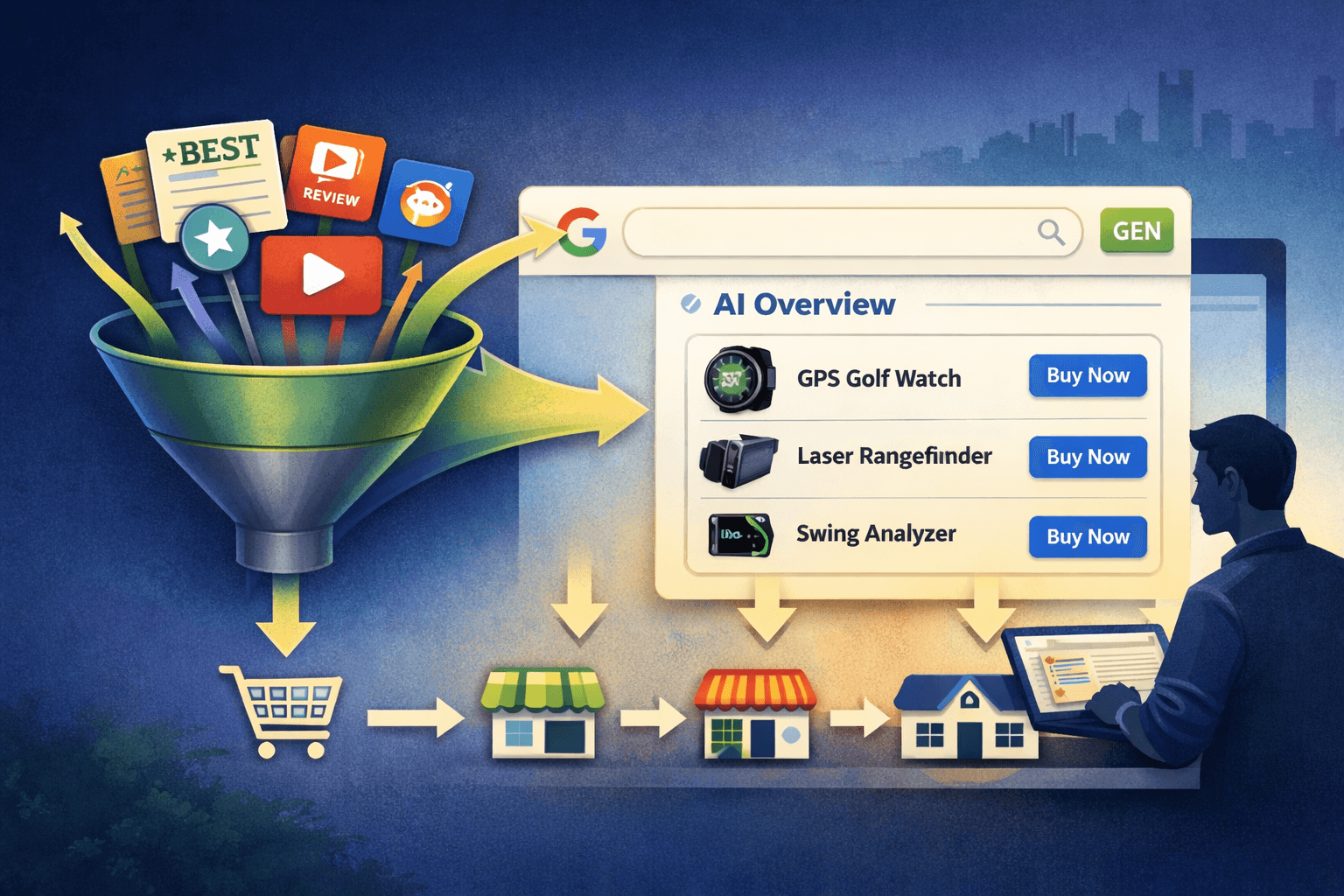
The real shift occurred in early November, when Google began linking product names inside AI Overviews directly to new search results. Those links pushed users deeper into commercial SERPs populated with shopping ads, ecommerce listings, and brand product pages.
In effect, Google introduced a new behavior loop:
User searches a generic “best” query
AI Overview presents a short list of recommended products
Clicking a product name launches a high intent commercial SERP
This is not just answer synthesis. It is funnel compression.
Why Search Demand Suddenly Spiked
From a behavioral standpoint, AI Overview removes three major points of friction in the buying journey.
1. Information overload disappears
Users are no longer forced to open ten tabs, read multiple listicles, or triangulate trust signals across random sites.
2. Research loops collapse
Feature comparisons, pros and cons, and alternatives are summarized instantly. Analysis paralysis is reduced.
3. Trust is transferred to Google
Whether deserved or not, recommendations framed as coming from Google feel neutral, authoritative, and unmotivated by affiliate commissions.
When you remove friction, more users complete the journey. When more users complete the journey, search demand rises downstream.
That is what the charts are showing.
The Strategic Implication for SEOs
AI Overview is not stealing traffic in the way most SEOs are framing it.
It is reallocating influence.
Instead of ranking first for a listicle, the new game is influencing the corpus of sources Google pulls from when generating AI Overviews. If your product is repeatedly mentioned across those sources, Google treats it as consensus.
This is less about ranking and more about probability.
How Google Builds AI Overview Product Lists
Google does not simply scrape one page and summarize it.
AI Overview relies on query fan out.
A single query like:
Best standing desk
Silently expands into dozens of subqueries:
Best standing desk for home office
Standing desk vs traditional desk
Is a standing desk worth it
Best standing desk 2025
Standing desk alternatives
Google pulls content from pages ranking for these variations and synthesizes a recommendation set.
If your product appears consistently across those fan out surfaces, your likelihood of inclusion increases.
Tactical Framework for Getting Products Mentioned
1. Stop targeting individual AI Overview citations
AI Overview sources refresh frequently. According to Ahrefs data, nearly half of citations change within days.
If you only chase the sites Google is citing today, you are playing reactive SEO.
Instead, aim for saturation across the ecosystem.
2. Target listicles at scale
Listicles remain the dominant source type for product mentions in AI Overviews.
Your objective is not one placement. It is many placements across:
“Best” posts
Comparison articles
Review roundups
Alternatives and versus pages
Use Ahrefs Brand Radar to:
Run a blank search
Open the cited pages report
Filter queries containing your target keyword
This surfaces the sites Google already trusts for AI synthesis.
3. Reverse engineer competitor coverage
The fastest wins come from pages that already mention competitors but exclude your brand.
In Brand Radar:
Enter your brand plus competitor brands
Hover over your brand and select “others only”
Open the pages report
Then filter for high probability fan out terms like:
best
top
review
comparison
versus
alternative
worth
These are not random blog posts. They directly influence AI Overview outputs.
4. Expand beyond blogs
AI Overview heavily cites non traditional SEO surfaces.
Based on current data:
YouTube is consistently cited
Reddit is heavily weighted
Quora still appears, though declining
This mirrors what we are also seeing in AI Mode and conversational search interfaces.
Tactically:
Seed product reviews with relevant YouTubers
Participate authentically in niche subreddits
Avoid forced brand drops that trigger moderation
Google does not need glowing endorsements. It needs repeated, contextual mentions.
A Necessary Reality Check
There is no public data yet proving that AI Overview inclusion directly increases revenue.
What we can observe with confidence:
Increased branded search demand
Increased downstream commercial SERP activity
Increased exposure to shopping and product pages
That does not guarantee conversion lift. Pricing, UX, trust signals, and fulfillment still matter.
SEOs should treat AI Overview as a demand shaping layer, not a magic sales machine.
Why This Matters Long Term
Google is no longer just indexing demand. It is manufacturing it.
For SEOs and marketers, this represents a shift from:
Ranking pages
toInfluencing recommendation systems
Those who understand this early will help brands appear inevitable, not just visible.
And in a search landscape increasingly dominated by AI interfaces, inevitability is the real moat.
Field Manual Entry Available
This post is adapted from a Crawled Field Manual entry documenting how Google’s AI Overview is shaping product demand inside the SERP, and how SEOs can influence inclusion through ecosystem-level visibility rather than traditional rankings.
The full Field Manual breaks this down into:
A repeatable framework for AI Overview product inclusion
Step-by-step workflows using Ahrefs Brand Radar
Clear guidance on where to invest effort and where not to waste time
Strategic context for how this fits into GEO and AI-era search
If you are building SEO strategies for brands, ecommerce, or product-led businesses in 2025, this is not optional reading.
👉 Access the Crawled Field Manual to see the full entry and related frameworks.