For more than two decades, search visibility meant one thing: rank on Google. Entire industries were built around mastering keywords, backlinks, metadata, and technical SEO.
That era is not ending. But it is being fundamentally reshaped.
A newly published academic paper on arXiv titled “Generative Engine Optimization: How to Dominate AI Search” confirms what many of us in the SEO and AI space have already been sensing. Search is no longer just about ranked links. It is becoming about synthesized answers generated by AI models that decide what information is shown, what is cited, and what is completely invisible.
This shift requires a new discipline. The authors call it Generative Engine Optimization, or GEO.
Here is what the study discovered, why it matters, and what it means for anyone who depends on online visibility.
From Search Engines to Answer Engines
Traditional search engines like Google and Bing operate on a familiar model. You type a query and receive a ranked list of websites. Your visibility depends on where you rank in that list.
Generative AI systems behave very differently.
Instead of presenting a list of links, they synthesize an answer directly using large language models. These answers are often supported by citations pulled from trusted sources, but the user may never need to click a website at all.
The study analyzed how these generative systems retrieve, select, and justify information across:
What they found confirms a major shift in how authority and visibility now work.
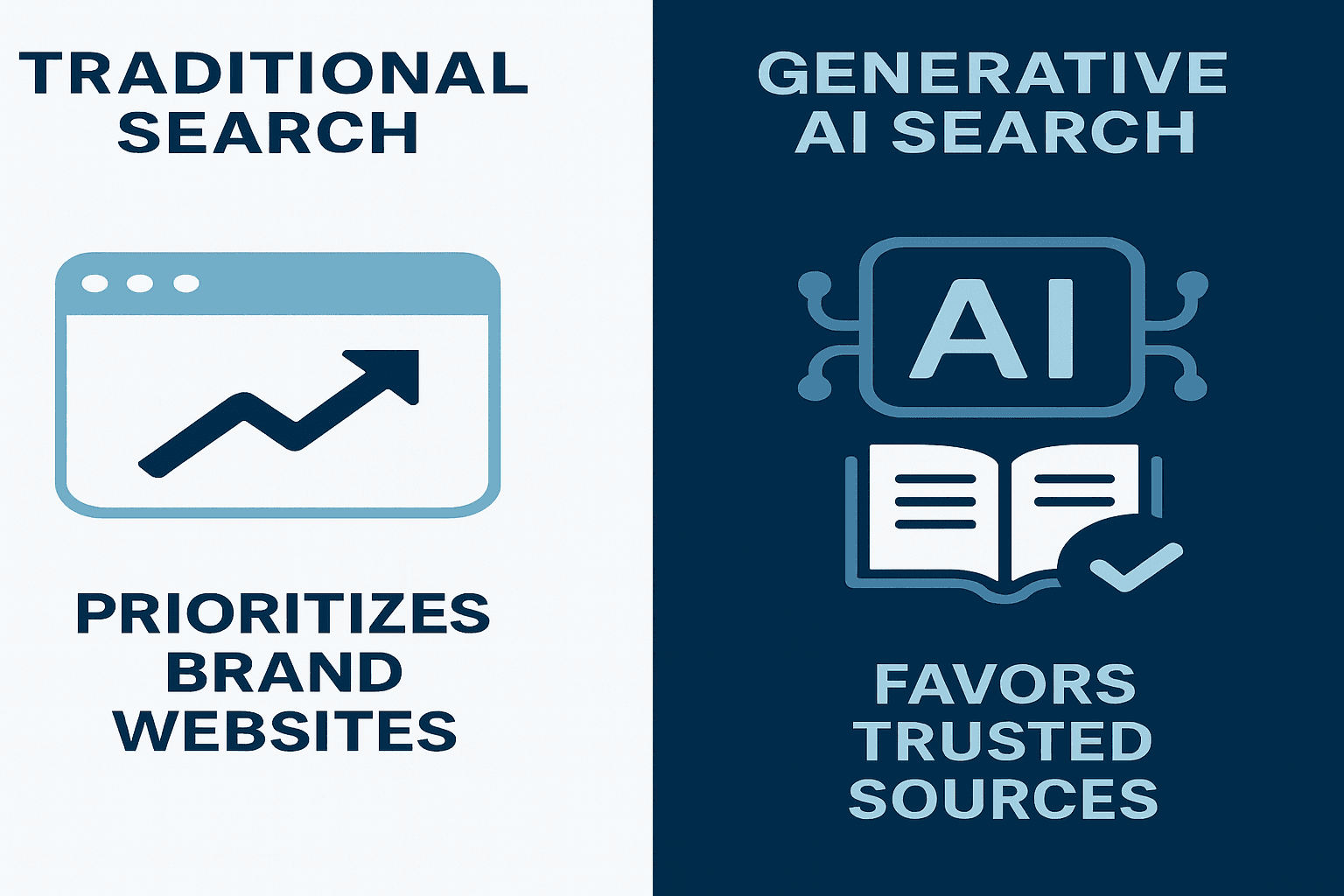
One of the most significant discoveries in the study is that generative search engines overwhelmingly favor earned media over brand-owned content.
This includes:
By comparison, content published directly on brand websites or social media platforms is cited far less frequently in AI-generated answers.
This represents a major shift from traditional SEO, where brand websites could compete directly for rankings with strong on-site optimization and backlinks. In generative search, third-party validation appears to be far more important than self-published authority.
In simple terms:
If the internet says you are credible, AI believes it.
If only you say you are credible, AI is far more skeptical.
Key Finding #2: Generative Engines Behave Very Differently from One Another
Another major insight from the study is that there is no single “AI search algorithm.”
Different generative systems show:
Different domain preferences
Different update speeds and freshness biases
Different levels of language stability
Different sensitivities to query phrasing
Different citation behaviors
What surfaces in one AI engine may not surface in another at all.
This means GEO is not a one-size-fits-all strategy. It is engine-aware, just like traditional SEO became Google-aware over time.
If your visibility strategy only accounts for one AI platform, you are already behind.
Key Finding #3: Query Phrasing Strongly Affects AI Visibility
The study also showed that small changes in how a question is phrased can significantly alter which sources are retrieved and cited.
This is important for two reasons:
It means AI discovery is highly sensitive to semantic framing.
It means content must be written in a way that naturally supports multiple phrasings of the same idea.
Traditional SEO trained people to think in terms of keywords. GEO requires thinking in terms of conceptual coverage and semantic completeness.
It is no longer enough to target a phrase. You must target the idea behind the phrase.
Key Finding #4: Machine-Readable Structure Matters More Than Ever
The authors repeatedly emphasize that structured, machine-scannable content outperforms unstructured content in generative retrieval.
This includes:
Clear section headers
Logical content hierarchy
Explicit claims and definitions
Source-supported statements
Well-organized factual blocks
Generative systems are not simply crawling pages. They are extracting meaning, relationships, and justifiable claims. If your content is difficult to parse, it is less likely to be used as a citation source.
This pushes content creation closer to knowledge engineering than traditional blogging.
I posted detailed instructions on how to create structured data in an article on LinkedIn.
Key Finding #5: Big-Brand Bias Is Real but Not Absolute
The study also confirms a big-brand advantage in generative search. Well-known companies and institutions are cited more frequently and more consistently.
However, the authors are careful to note that this bias is not unbeatable.
Smaller publishers that demonstrate:
Clear topical authority
Strong third-party validation
High-precision informational content
Strong cross-source consistency
can still surface in generative answers.
The barrier is higher than it was in traditional SEO, but it is not closed.
Why This Study Matters
This paper is important for one simple reason. It is one of the first large-scale empirical studies to treat generative search as its own visibility ecosystem, not just a variation of Google.
It confirms that:
Visibility is shifting from rankings to citations.
Authority is shifting from self-published content to earned validation.
Optimization is shifting from keyword placement to structured knowledge design.
Discovery is shifting from link navigation to answer synthesis.
In short, we are no longer optimizing for search engines alone. We are optimizing for generative systems that decide what becomes “truth-sized” information in public view.
This has massive implications for:
Traditional SEO vs Generative Engine Optimization
Traditional SEO asks:
“How do I rank higher on Google?”
GEO asks:
“How do I become a source that AI trusts enough to cite?”
SEO focuses on:
GEO focuses on:
SEO is about being found.
GEO is about being used.
What This Means for Your Strategy Right Now
If your current visibility strategy relies entirely on:
Your own blog
Your own website
Your own social channels
you are exposed.
Generative systems are not obligated to surface your content simply because it exists. They surface what they trust, what they can justify, and what is widely corroborated.
Your digital footprint now needs to exist across the web, not just on your own properties.
This is where Generative Engine Optimization becomes not just a marketing tactic, but a reputation infrastructure strategy.
Get the GEO Checklist
Put the research into action with the Practical GEO Checklist, distilled directly from this academic study.
Download the GEO Checklist
Use it to audit your current visibility across AI search engines and identify exactly where your brand is strong and where it is invisible.
Want resources like this delivered straight to your inbox every month?
Subscribe to the Crawled Field Manual for just $1 per month and get actionable GEO frameworks, AI search breakdowns, and visibility strategies you can actually use.
No fluff. No speculation. Just the playbooks.